FOUNDER • WEB & MOBILE APP • SEMICONDUCTOR EDUCATION
Fab Path: Learn How Chips Get Made
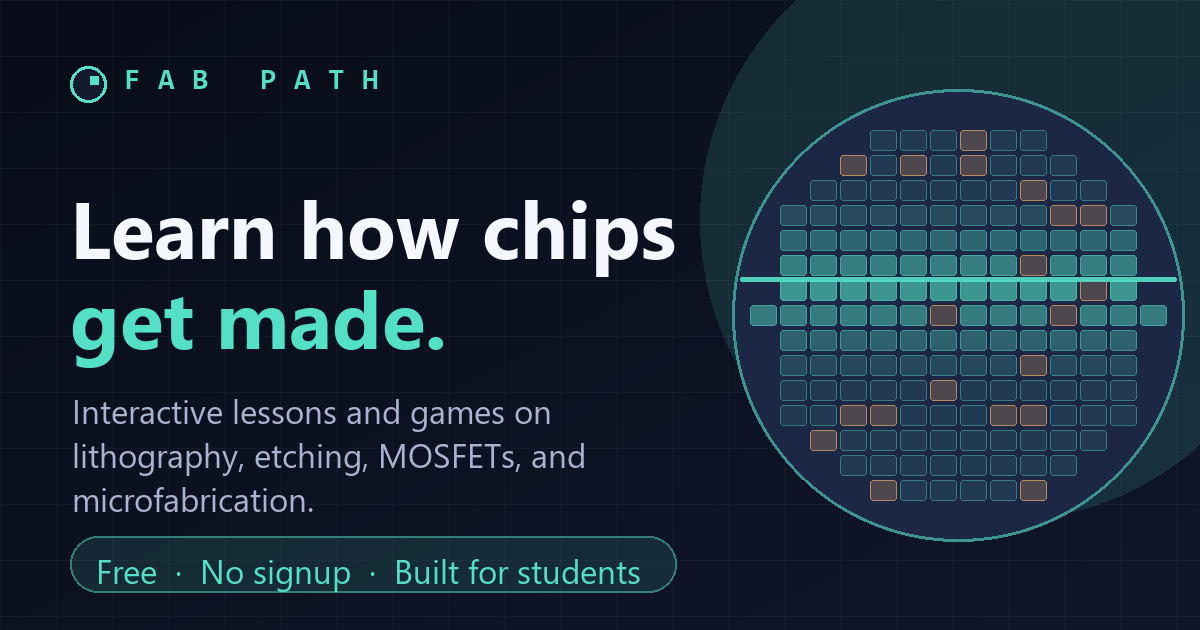
The free, interactive platform behind my company, Fab Path L.L.C. I founded it, designed it, wrote it, and built it, and it is live today at fab-path.com.
01 / OVERVIEW
Semiconductors are hard to learn from a textbook. I built a better way in.
While fabricating microsupercapacitors for my thesis, I kept noticing how little free, interactive material existed for people trying to learn semiconductor fabrication from the ground up. Most resources are either dense textbooks or paywalled courses.
Fab Path is my answer: illustrated lessons, custom vector diagrams, quizzes, hands-on games, 3D scenes, and virtual labs, covering everything from how a chip is made to how it is packaged and shipped. I wrote the lessons and questions, drew the diagrams, and built the software myself.
02 / THE COMPANY
From a side project to a registered company.
In October 2026 I founded Fab Path L.L.C., a limited liability company registered in the state of California, to run the platform as a real business. I am its founder and CEO.
Standing it up meant more than shipping code: I registered the company, set up the fab-path.com domain and business email, and wrote the privacy policy, terms of use, and sources pages. The lessons credit their references, and the site is independent and not affiliated with any company it mentions.
04 / CONTENT AT SCALE
Seven full courses, all written from scratch.
Lessons live across the platform today, each with its own quiz.
Full courses, from how a chip is made to MEMS, supercapacitors, transistors, and biosensors.
Virtual labs where learners draw their own designs and test them on simulated instruments.
Sand to Chip traces a chip from quartz sand through purification, crystal growth, and the cleanroom, then the layer-building tools, lithography, doping, the CMOS process flow, yield, packaging, and the industry itself — 48 short units across 8 parts.
MEMS & Microfabrication, Supercapacitors (grounded in my own thesis research on 3D interdigitated glassy-carbon devices), BioFETs & MOSFETs, Glucose Sensors, Blood-Brain Barrier on a Chip, and Neural Interface Chip round out the platform, with a Carbon-Based Materials course on the way.
06 / BEYOND LESSONS
Learners don’t just read about a fab. They use one.
Past slides and quizzes, I built interactive tools so people can see and try the physics for themselves.
Virtual Fab Labs
Learners draw their own photomask layers, stack materials, set exposure and bake steps, build devices, and test them on simulated instruments. The layout drives the numbers, and designs can be exported in standard layout formats.
Virtual Foundry
A guided Sand to Chip process with nine stations, from sorting sand to packaging, where each choice carries through to the final chips and yield.
3D Scenes & Simulators
Forty interactive 3D scenes built with three.js, plus animated simulators in the lessons, so a crystal puller or an etch profile can be turned and explored instead of imagined.
iOS App
A companion iPhone app built with Capacitor from the same codebase, with study reminders, haptics, and progress backup.
07 / DESIGN ITERATION
40 slides before a single question was too many.
I originally built each unit of Sand to Chip as one long study module — around 40 slides — followed by a set of quizzes. Going through my own course, I found myself fatigued long before I reached a question, and realized learners would feel it too.
So I rebuilt it: every course on the platform now runs as many short units of about 6–8 slides, each one followed immediately by its own quiz, grouped into named “parts” for orientation. It touched course data, the learning-path renderer, the practice engine, and every existing unit page across all the courses.
One long module per unit, all the way through before any quiz.
Short units grouped into parts, each ending in an immediate quiz.
08 / UNDER THE HOOD
A static site that outgrew its own assumptions.
Fab Path is hand-written HTML, CSS, and JavaScript — no framework, no build step. It started as a purely client-side tool and grew a real backend only where a real need showed up.
Progress & Content Engine
Course structure, quiz banks, and per-unit diagrams live in plain JS data files. Streaks, XP, and completion are tracked in localStorage, so learners can start with no account at all.
Cross-Device Sync
Optional email sign-in (one-time code or password) is backed by Supabase. Signing in merges the cloud copy with whatever progress already exists on the device, so switching devices never overwrites work. Pages ship with a content security policy, and the server-side functions are rate limited.
Self-Hosted & Lightweight
Inter and JetBrains Mono are self-hosted, subset, and preloaded. Every diagram is inline SVG, not an image request, so pages stay fast.
Deployed & Indexed
Statically hosted on GitHub Pages at the custom domain fab-path.com, with a generated sitemap covering nearly 500 URLs, Open Graph tags, and a canonical URL on every page.
09 / TRY IT
See it live.
Fab Path is free, requires no signup to start, and keeps growing: new courses and tools are still being added.