MEDICAL DEVICE • SOLIDWORKS • FEA
Humeral Intramedullary Rod
Design and structural analysis of a titanium intramedullary fixation device for humeral fractures, with emphasis on mechanical performance, anatomical compatibility, and medical-device design requirements.
01 / OVERVIEW
Designing a lower-profile fixation device for humeral fractures.
Intramedullary rods are implanted within the medullary canal of long bones to stabilize fractures and maintain alignment during healing.
This project focused on the design of a humeral intramedullary rod intended to provide structural stability while reducing tissue irritation through changes to rod geometry and proximal bend angle.
02 / DESIGN INPUTS
Engineering around anatomy and clinical constraints.
The device was developed around anatomical dimensions, fixation requirements, material performance, biocompatibility, and mechanical loading conditions.
Anatomy
Rod geometry and dimensions were selected to fit within the humeral medullary canal.
Fixation
Proximal and distal screw locations were incorporated to stabilize fractured bone segments.
Material
Ti-6Al-4V was selected for its high strength, biocompatibility, corrosion resistance, and suitability for orthopedic implants.
Mechanical Strength
The device was evaluated under bending, compression, and torsional loading conditions.
Standards
Mechanical testing concepts were developed with consideration of ASTM F1264.
Manufacturability
Forging, machining, drilling, polishing, and heat treatment were considered as potential manufacturing methods.
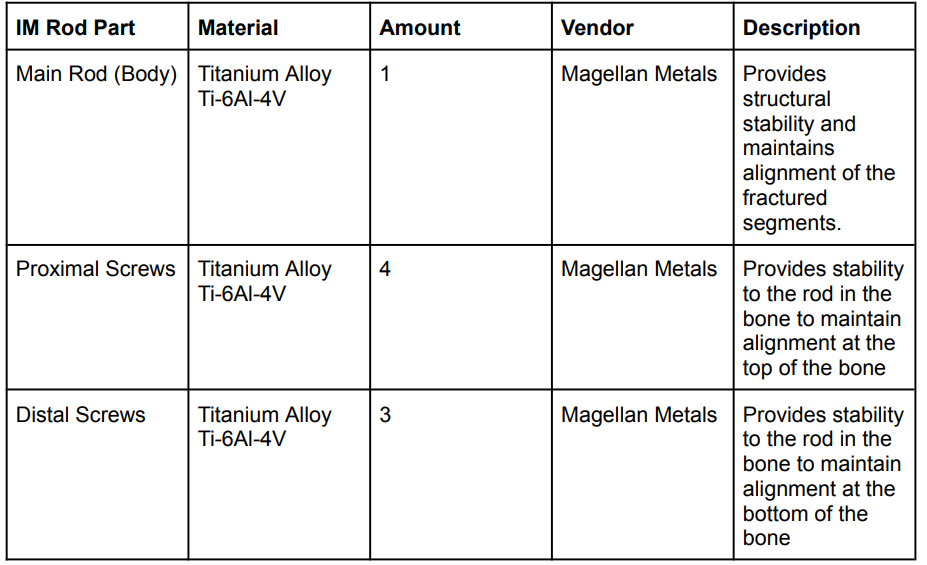
Bill of materials and component specification
03 / CAD DESIGN
SolidWorks device development.
The intramedullary rod, fixation holes, proximal and distal geometry, and associated screws were modeled in SolidWorks.
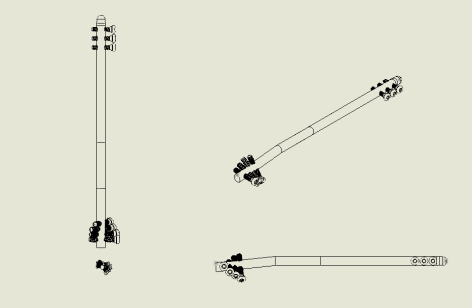
Engineering drawings and assembly views were developed to define critical dimensions and communicate the final design.
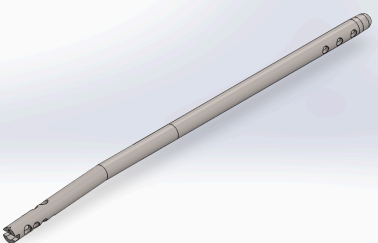
Isometric view of the intramedullary rod design
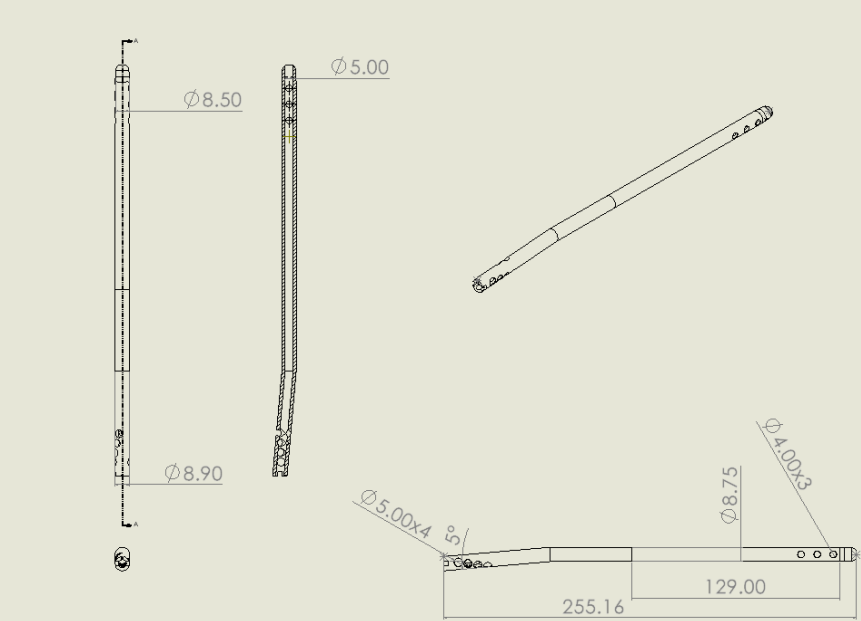
Dimensioned intramedullary rod engineering drawing in Milimeters
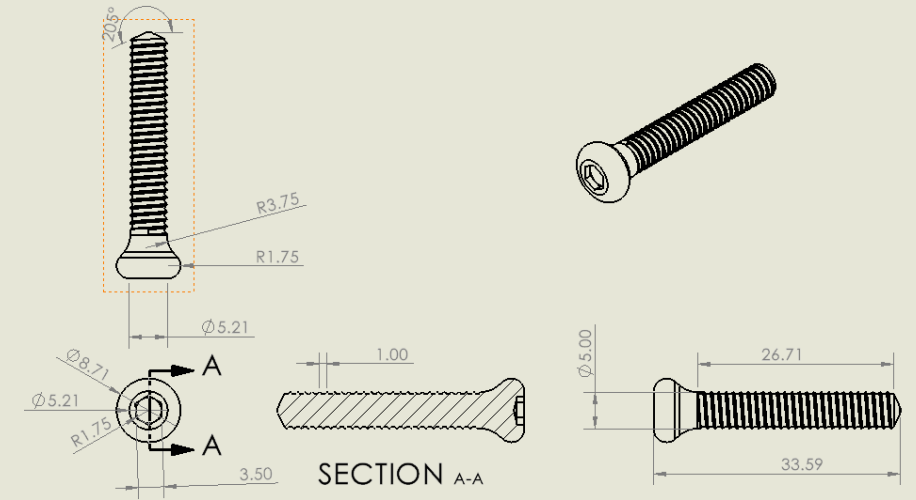
Dimensioned proximal screws engineering drawing in Milimeters
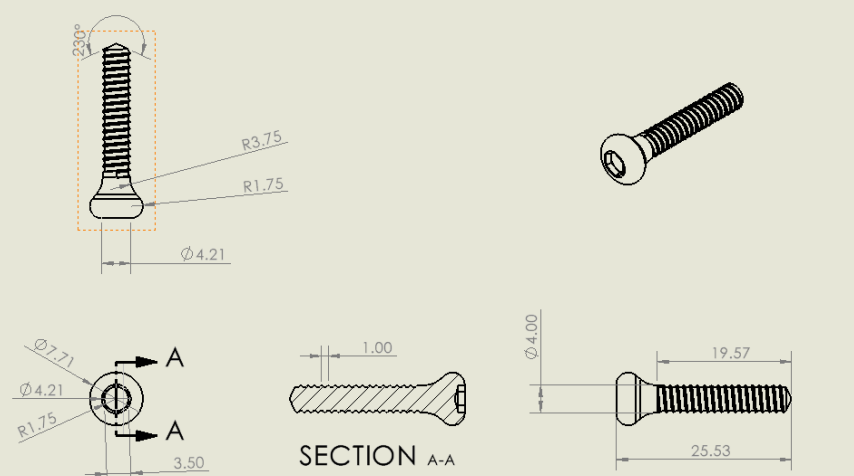
Dimensioned distal screws engineering drawing in Milimeters
04 / MECHANICAL ANALYSIS
Evaluating the rod under multiple loading conditions.
Analytical calculations and finite-element analysis were used to estimate structural performance and identify high-stress and high-displacement regions.
Bending
Three-point bending analysis was used to evaluate flexural behavior and maximum bending stresses.
Compression
Axial and localized loading conditions were evaluated to estimate compressive strength and deformation.
Torsion
Torsional loading was analyzed to assess resistance to twisting during physiological loading.
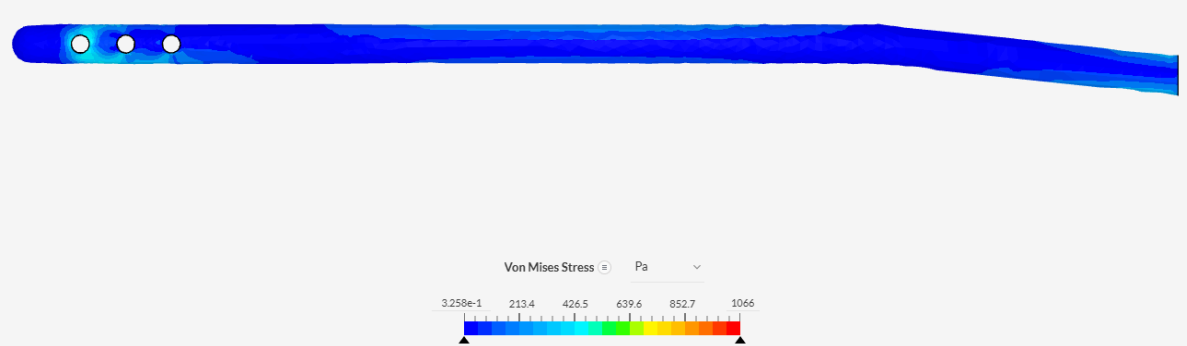
Three-point bending FEA — stress distribution
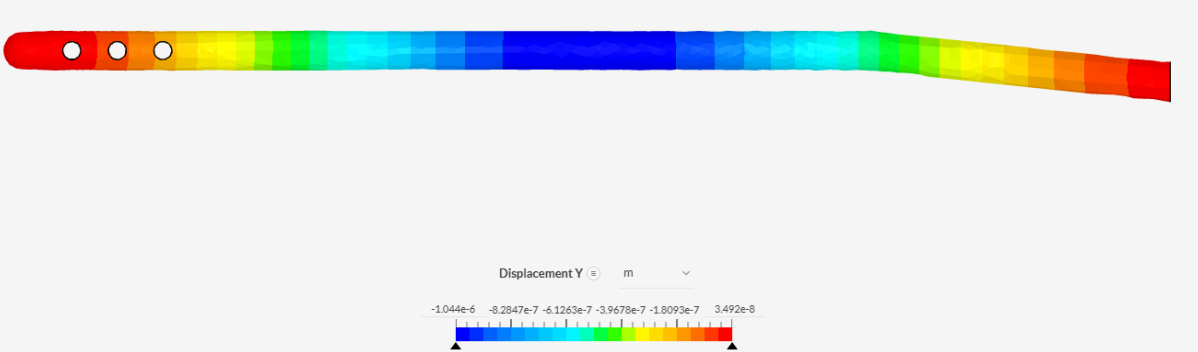
Three-point bending FEA — displacement
05 / KEY RESULTS
The design met the intended structural requirements within the scope of the project.
FEA was used to visualize Von Mises stress, displacement, and strain distributions throughout the rod under bending and compression.
Analytical calculations were compared with simulated behavior to evaluate whether the titanium structure could tolerate expected loading conditions.
The work also highlighted how the rod geometry, fixation-hole locations, proximal bend, and material selection influence both structural performance and patient compatibility.
06 / MANUFACTURING
From titanium stock to finished implant.
A potential manufacturing route included forging Ti-6Al-4V to establish the rough rod geometry, followed by turning, milling, drilling, polishing, and stress-relief heat treatment.
The design also considered final surface finish, durability, sterilization, and manufacturing compatibility with orthopedic-device requirements.
07 / ENGINEERING TAKEAWAY
Integrated mechanical and medical-device design.
This project combined CAD, structural mechanics, finite-element analysis, material selection, standards-based design considerations, and manufacturing planning within a single orthopedic-device development workflow.
FULL PROJECT DOCUMENTATION
Intramedullary Rod Engineering Report
View the complete project report for additional details on medical-device design, engineering calculations, material selection, structural analysis, finite element analysis, manufacturing considerations, and technical specifications.
View Full Engineering Report ↗08 / TECHNICAL SKILLS